Know where your operation is exposed before something fails.
A practical EMS cybersecurity assessment for the systems, vendors, access, and downtime workflows your crews depend on.
Forward Security Labs reviews the operational side of cyber risk, including ePCR, dispatch dependencies, field devices, cloud vendors, user access, billing systems, continuity procedures, incident escalation, and the documentation leadership needs when technology stops working.
Cyber incidents become EMS operations incidents.
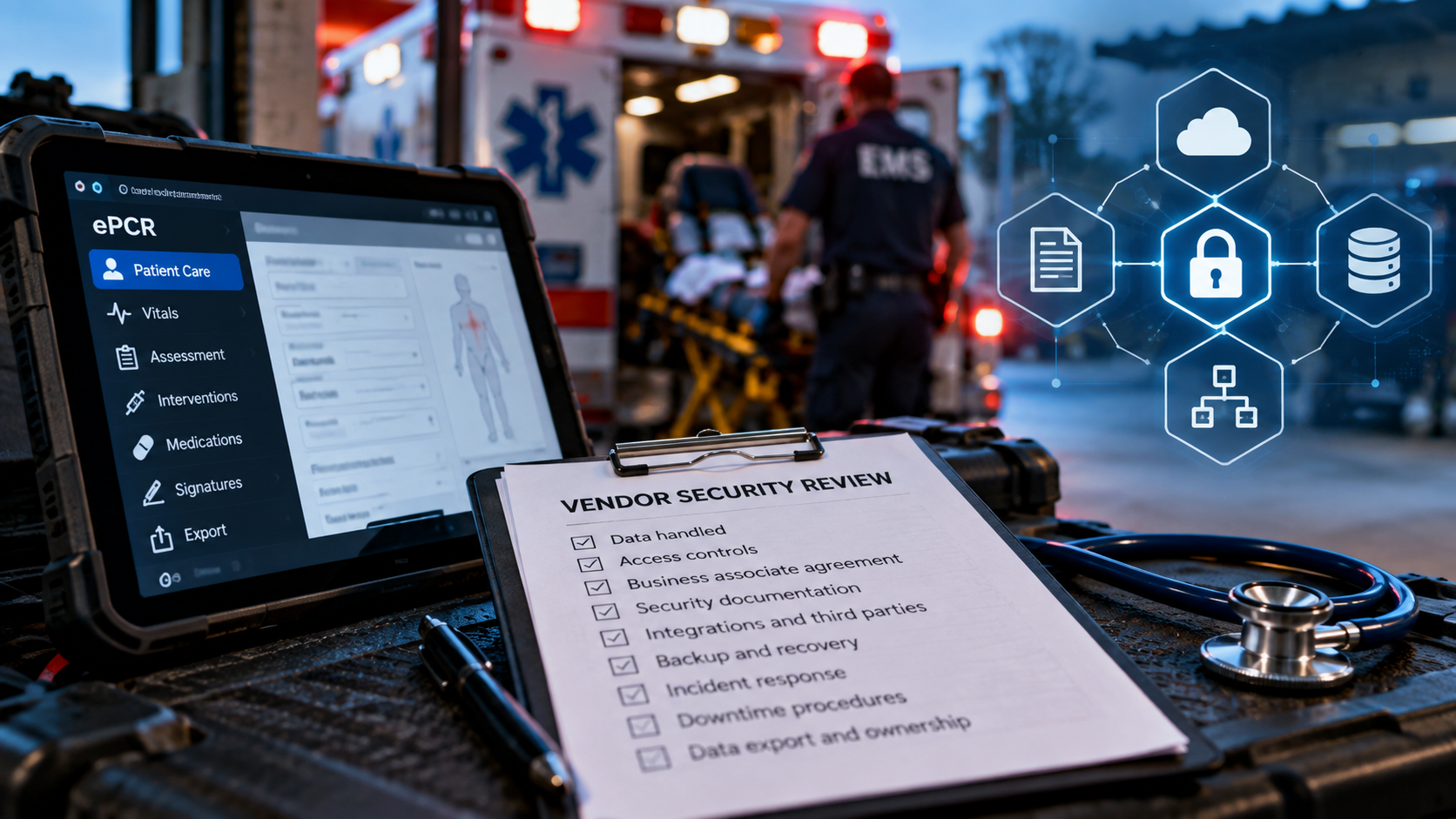
An EMS cybersecurity assessment should answer a practical question: what happens to patient care, documentation, communication, billing, and leadership decisions when a critical system or vendor is suddenly unavailable?
ePCR or CAD goes down.
Calls still come in. Crews still document care. Hospital handoffs, reports, billing, and later reconciliation do not disappear because a cloud service did.
Someone else has access.
Software vendors, billing companies, integrations, cloud providers, MSPs, and remote support all become part of the agency’s operational risk.
The paper plan meets the street.
A procedure can look complete until crews, dispatch, supervisors, administration, and leadership discover they expected different things.
What we actually review.
The FSL EMS cybersecurity assessment focuses on the systems and decisions that affect operations: governance, vendor risk, access, continuity, documentation, and practical security controls.
The objective is not to turn your ambulance service into a technology company. It is to make technology less likely to become the reason the operation fails.
You should know what to do when we leave.
Every EMS cybersecurity assessment ends with practical output that leadership can use.
Executive Readiness Summary
A concise leadership view of the cybersecurity, vendor, continuity, and operational issues that matter most.
Critical Dependency Map
A practical picture of the systems, people, vendors, and workflows required to keep delivering care.
Prioritized Findings
Findings organized by urgency and operational impact instead of pretending every recommendation is an emergency.
30 / 60 / 90-Day Action Plan
A realistic sequence for immediate fixes, near-term coordination, and longer-term improvement.
Cybersecurity advice from someone who understands the truck.
Michael Messina brings more than two decades in emergency healthcare, including paramedic and EMS supervisory experience, together with formal cybersecurity education and work focused on governance, risk, compliance, continuity, and preparedness.
That matters because an EMS cybersecurity assessment should account for mobile crews, devices outside the station, healthcare data, outside vendors, dispatch dependencies, and an operation that cannot simply close while IT fixes something.
Four steps. No mystery theater.
Define the environment.
Systems, vendors, documentation, concerns, ownership, and known trouble spots.
Examine the operation.
Conduct the EMS cybersecurity assessment across the agreed systems, workflows, access, and dependencies.
Separate signal from noise.
Identify immediate issues, near-term improvements, and longer-term remediation.
Decide what happens next.
Review priorities and identify anything that belongs with your MSP, vendor, counsel, or another specialist.
What this assessment is not.
Not Penetration Testing
FSL does not attempt to exploit agency networks, applications, endpoints, or vendor systems.
Not Managed Security
This is not a SOC, MDR service, EDR-management service, or emergency technical incident-response retainer.
Not Legal Advice
Legal and regulatory interpretation should be confirmed with qualified counsel when necessary.
Not a Certification
An EMS cybersecurity assessment does not certify HIPAA compliance or guarantee that a cybersecurity incident will be prevented.
Start with the problem before buying the solution.
The focused EMS cybersecurity assessment is designed as a practical starting point for a typical single EMS organization.
Multi-agency environments, multiple locations, onsite work, implementation, extensive documentation review, or materially expanded technical scope are quoted separately.
Fixed-scope starting price. Final scope is confirmed before work begins.
Fix what matters. Ignore what does not.
The EMS cybersecurity assessment can stand alone. If follow-on work makes sense, FSL can support selected remediation, documentation, vendor risk, continuity, preparedness, and exercises.
Policy & Documentation
Incident response, downtime, access management, vendor risk, continuity, and supporting procedures.
Vendor Risk Support
Clarify vendor responsibilities, access, documentation, dependencies, and unresolved security questions.
Downtime & Continuity
Build workflows crews, dispatch, supervisors, billing, and leadership can actually use.
Ransomware Tabletop
Test decisions, communications, escalation, continuity, and recovery before the real event.
Keep building readiness.
Emergency Medical Software Compliance
Questions EMS leaders should ask before buying, renewing, or relying on critical software.
EMS Downtime Exercise Guide
Test what happens when technology, communications, or documentation workflows stop.
Healthcare Compliance Support
HIPAA readiness, documentation, risk-analysis support, and remediation planning.
EMS Cybersecurity Assessment FAQ
What is an EMS cybersecurity assessment?
An EMS cybersecurity assessment reviews the systems, vendors, access practices, documentation, downtime capabilities, and operational dependencies that affect an EMS organization’s cybersecurity readiness.
Does the assessment include our ePCR platform?
Yes, within the agreed scope. FSL can review how your agency relies on ePCR, user access, vendor support, integrations, downtime procedures, and recovery expectations.
Does this replace a HIPAA Security Risk Analysis?
No. The assessment can identify security, privacy, documentation, and operational issues that may affect HIPAA readiness, but it does not automatically replace another separately defined regulatory assessment.
Can FSL work with our MSP or IT provider?
Yes. FSL can handle governance, documentation, risk, continuity, vendor coordination, and remediation tracking while technical providers remain responsible for the systems and services they manage.
How much does the EMS cybersecurity assessment cost?
The focused EMS cybersecurity assessment starts at $995 for a typical single EMS organization. Expanded environments, onsite work, implementation, or materially larger scopes are quoted separately.
Do not discover the weak point during the outage.
Request an EMS cybersecurity assessment and tell us what type of organization you operate, what systems you rely on, and what concerns you most.