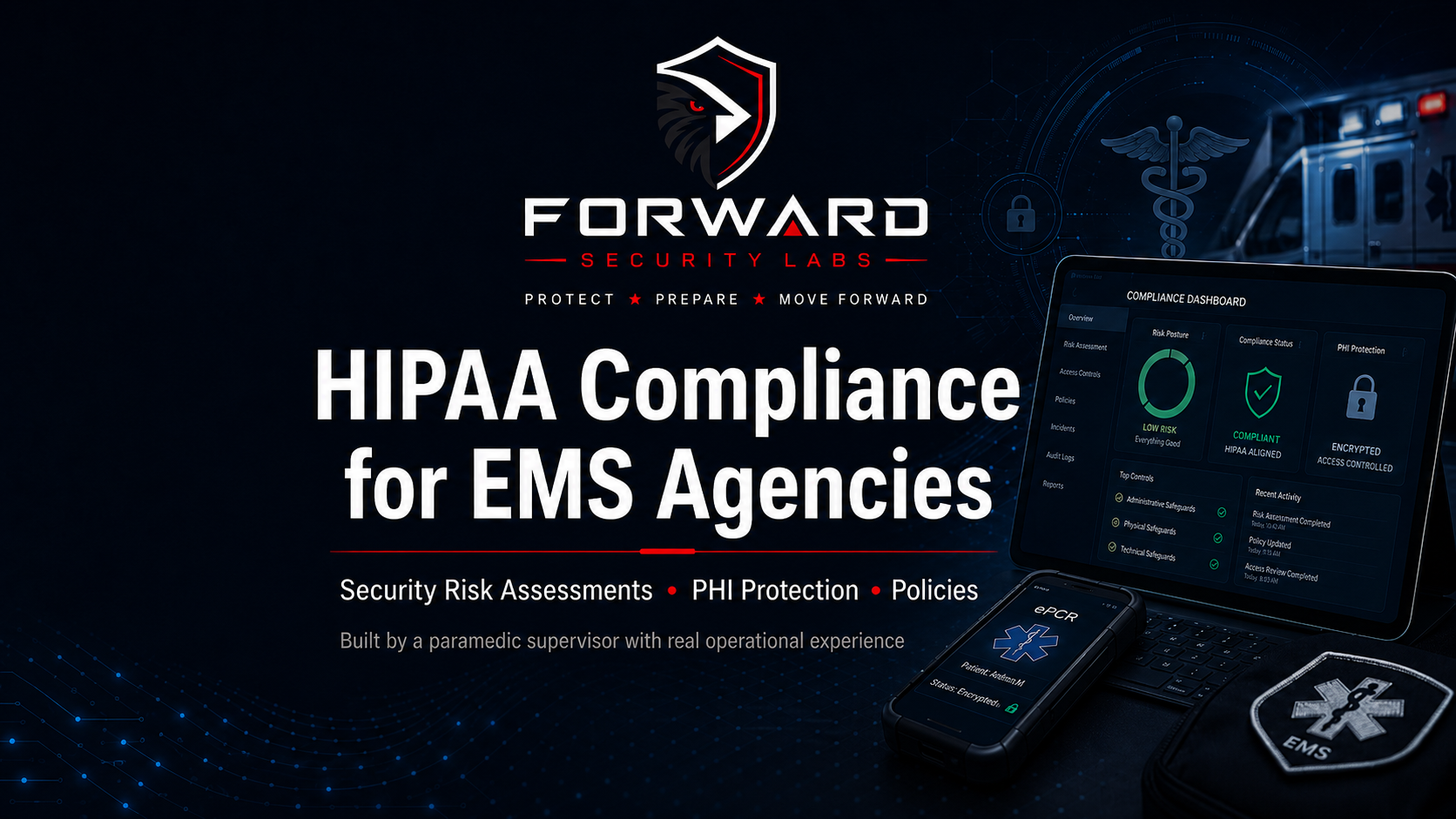
EMS Agencies and HIPAA Compliance: What You Need to Know
Most people who write about HIPAA compliance have never been on an ambulance.
They have not sat in the back of a unit at 2 AM trying to document a patient while also managing an IV line. They have not handed off a run report at a hospital and wondered who else is going to see that information. They have not supervised a crew that uses the same tablet for ePCR software, personal text messages, and Google Maps.
I have. Twenty years of it.
That background is why I am writing this. EMS agencies have a specific HIPAA compliance problem that most healthcare compliance consultants do not fully understand. They understand the regulation. They do not always understand the operational reality that makes EMS agencies HIPAA compliance genuinely difficult for a working organization.
This article covers what EMS agencies actually need to know about HIPAA compliance, where the real gaps tend to be, and what to do about them.
According to the HHS Office for Civil Rights, a HIPAA Security Risk Assessment is a required element of compliance for all covered entities, not a best practice or optional step. EMS agencies are covered entities. That requirement applies to you.
EMS Agencies HIPAA Compliance: What the Regulation Actually Requires
Emergency medical services organizations that transmit protected health information electronically are covered entities under HIPAA. That includes virtually every EMS agency operating today. ePCR software, hospital interfaces, billing systems, secure messaging platforms, and email all involve electronic PHI in some form.
Being a covered entity means the full HIPAA Privacy Rule and Security Rule apply. That includes the requirement to conduct and document a HIPAA Security Risk Assessment, maintain written policies and procedures, train workforce members, manage business associate agreements, and implement appropriate technical, physical, and administrative safeguards.
Most EMS leaders know they are covered entities. Many have some version of a HIPAA policy. Fewer have a current, documented Security Risk Assessment. Fewer still have policies that actually reflect how the agency operates today rather than how it operated when the policies were last updated. That gap is where the compliance exposure lives.
The Specific HIPAA Compliance Challenges EMS Agencies Face
EMS agencies HIPAA compliance is not harder than hospital compliance because EMS organizations are less serious about it. It is harder because the operational environment creates genuine challenges that a traditional healthcare compliance framework was not designed around.
Mobile Workforce and Shared Devices
An EMS crew may use the same tablet for ePCR documentation, hospital communication, medication reference, and navigation. That device may be shared across multiple crews and multiple shifts. It leaves the building on every call. It connects to hospital Wi-Fi, public networks, and the agency’s own system depending on where the call takes place.
HIPAA requires that access to ePHI on portable devices be controlled and that devices be encrypted and have remote wipe capability. Many agencies have made progress here. The documentation of those controls, which is what a Security Risk Assessment captures, is often incomplete. Incomplete documentation is still a compliance gap even if the controls exist.
ePCR Systems and Third-Party Software
Most EMS agencies use an ePCR platform from a third-party vendor. That vendor is a business associate. A current, signed Business Associate Agreement needs to be in place. Beyond the ePCR, agencies may use third-party billing services, scheduling software, payroll platforms, body camera systems, radio systems connected to CAD, and communication apps. Any vendor or contractor who creates, receives, maintains, or transmits PHI on behalf of the agency is a business associate and needs a signed BAA.
Auditing the full list of business associates and confirming current BAAs are in place is consistently one of the first gaps found in an EMS agencies HIPAA compliance review.
Informal Communication Channels
EMS crews communicate on the radio, on personal cell phones, by text, through group chats, and face to face at the station. Some of that communication involves patient information. A crew texting a hospital charge nurse about a patient coming in on a personal phone may be transmitting ePHI over an unsecured channel. A shift supervisor sending run details in a group text is doing the same thing. None of this is malicious. All of it is a potential HIPAA issue.
Written policies about how patient information may be communicated, and what platforms are approved, are required under EMS agencies HIPAA compliance rules. Enforcing those policies in a mobile environment is a real challenge that has to be addressed in your compliance program.
Training That Actually Reaches the Field
HIPAA requires workforce training. For an EMS agency, that means full-time medics, part-time per diem staff, volunteers, student observers, and anyone else who may have access to patient information. Getting training documentation for a mixed workforce that includes volunteers and rotating per diem staff is harder than it sounds. Many agencies have records for full-time employees and gaps for everyone else.
The training also needs to be meaningful. Clicking through a generic online module built for a hospital receptionist is not the same as training built around EMS operations specifically.
Incident Reporting and Breach Response
A lost phone with unencrypted patient data is a potential breach. A crew member discussing a patient with a family member is a potential privacy violation. An email sent to the wrong address containing run information is a potential breach. An ePCR accessed by a former employee whose credentials were not disabled is a potential breach.
HIPAA requires a documented breach notification procedure, a log of incidents and violations, and a process for determining whether a reportable breach has occurred. Many EMS agencies handle incidents informally, which means the documentation that would protect them in an audit does not exist.
What a HIPAA Security Risk Assessment Covers for EMS Agencies
The HIPAA Security Risk Assessment is the foundation of EMS agencies HIPAA compliance. OCR enforcement actions have specifically cited the absence of a completed risk assessment as a primary violation. It is not optional and it cannot be substituted with a general policy review.
For an EMS agency, a Security Risk Assessment identifies and documents:
- Where ePHI is created, received, maintained, and transmitted
- What threats and vulnerabilities exist for each system or location that holds ePHI
- What controls are currently in place and whether they are adequate
- What the likelihood and impact of a breach would be for each identified risk
- What remediation steps are needed to bring risk to an acceptable level
For a working EMS agency, that means documenting the ePCR system, the tablets or phones crews use, the CAD interface, the billing system, the email environment, secondary communication platforms, physical records if they exist, and the access controls around all of it. The output is a written document that demonstrates the agency has assessed its risk. That document needs to be current. An assessment from several years ago that has not been reviewed does not satisfy the requirement if the agency’s systems, vendors, or operations have changed since then.
What EMS Agencies Should Have on File for HIPAA Compliance
A compliant EMS agency should be able to produce the following if asked by OCR, a hospital partner, a cyber insurance carrier, or a mutual aid agency conducting due diligence:
- A current HIPAA Security Risk Assessment
- Written HIPAA Privacy and Security policies and procedures
- A Notice of Privacy Practices
- Signed Business Associate Agreements with all applicable vendors
- Workforce training documentation
- An incident log and breach response procedure
- A designated Privacy Officer and Security Officer
- Documentation of physical and technical safeguards for devices that hold ePHI
Most EMS agencies have some of this. Few have all of it current and documented in a way that would hold up under scrutiny.
Why Cyber Insurance Makes EMS Agencies HIPAA Compliance More Urgent
EMS agencies that carry cyber liability insurance, or that are being required to obtain it by their municipality or medical director, are increasingly being asked to demonstrate HIPAA compliance as part of the underwriting process. Insurers want to know whether a Security Risk Assessment has been completed, whether encryption is in place on portable devices, whether a breach response plan exists, and whether training has been documented.
Incomplete EMS agencies HIPAA compliance documentation can affect coverage, premiums, or whether a claim gets paid after an incident. Getting documentation in order before applying for or renewing cyber coverage is significantly easier than trying to do it after a claim is denied.
Where EMS Agencies Should Start on HIPAA Compliance
If your EMS agency does not have a current HIPAA Security Risk Assessment on file, that is the first priority. Everything else in an EMS agencies HIPAA compliance program builds on the risk assessment because it tells you where your actual gaps are.
After that, the practical next steps are:
- Audit your current policies and identify what is outdated or missing
- Pull your vendor list and confirm BAAs are in place for every applicable relationship
- Confirm device encryption and remote wipe capability on all field devices
- Document your training records and identify gaps in your workforce
- Create or update your breach response procedure and incident log
- Designate a Privacy Officer and Security Officer if you have not already
None of this requires becoming a compliance expert. It requires working with someone who understands both the regulatory requirements and the operational environment of a working EMS agency. That combination is harder to find than it should be.
Forward Security Labs provides HIPAA compliance consulting, security risk assessments, and GRC documentation for EMS agencies, healthcare organizations, and small businesses. Based in Wolcott, Connecticut. Founded by a U.S. Army combat veteran and paramedic supervisor with 20+ years in emergency healthcare. SDVOSB pending. SAM.gov registered. CAGE: 1AFL4.