Tabletop Exercise for Small Businesses
A tabletop exercise small business teams can run is one of the highest-value preparedness activities available, and most small businesses have never done one.
A tabletop exercise is a structured, discussion-based practice session where your team walks through a realistic emergency scenario and works out what they would do, step by step, before the real thing happens.
No systems get shut down. No actual emergency is created. The only thing at stake is the quality of the conversation. And that conversation is exactly what separates organizations that respond well to incidents from organizations that figure it out under pressure.
For small businesses, a tabletop exercise small business version is one of the highest-value preparedness activities you can run. It costs almost nothing compared to what an unmanaged incident can cost, and it reveals gaps that no policy document or checklist will ever surface.
What a Tabletop Exercise Small Business Actually Covers
A tabletop exercise small business can cover any scenario that represents a realistic threat to your organization. The most common and most valuable scenarios for small businesses are:
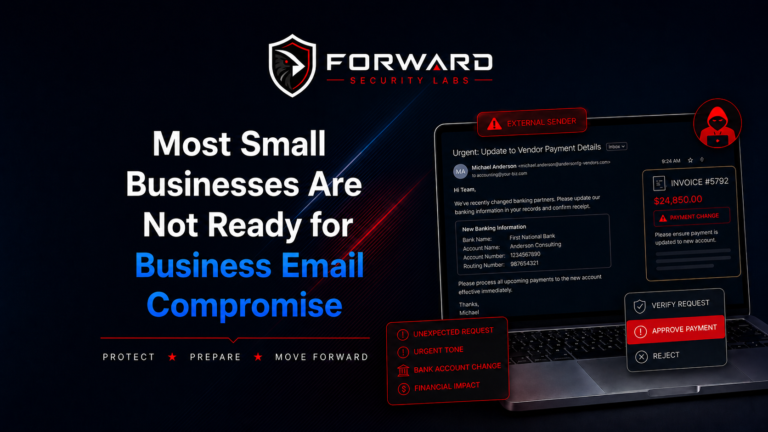
Business Email Compromise
A fake invoice, a vendor banking change, or an urgent wire transfer request. The most financially damaging cyber threat facing small businesses today. A tabletop exercise walks your finance team through what to verify before any money moves.
Ransomware Attack
Your systems go down. Files are encrypted. A ransom demand arrives. Your team has to decide what to do, in what order, with what information. A tabletop exercise small business scenario covers detection, containment, the ransom decision, business continuity, and recovery.
System Outage or Key Person Loss
Your software goes down. Your most important employee leaves. Your vendor disappears. Can the business keep running? A tabletop exercise small business continuity scenario finds out.
Workplace Emergency
For healthcare organizations, EMS agencies, schools, and retail businesses, active threat, fire, and other physical emergency scenarios are just as important as cyber scenarios. A tabletop exercise small business teams can run for these covers lockdown, evacuation, communication, and recovery.
Why Small Businesses Need Tabletop Exercises
Small businesses are often told that tabletop exercises are for large organizations with formal security teams. That is wrong. The tabletop exercise small business model exists precisely because small organizations are more vulnerable to the same threats, not less, and have fewer resources to recover when something goes wrong.
Here is why small businesses specifically need them:
One Person Does Everything
In a small business, the same person may handle invoices, vendor communication, payroll, and purchasing. That concentration of responsibility creates significant risk if that person is not practicing what to verify before taking action. A tabletop exercise small business scenario builds the habit of pausing and verifying before it matters.
No Formal Incident Response Plan
Most small businesses do not have a written incident response plan. When something goes wrong, the team is making it up in real time. A tabletop exercise small business format does not require a formal plan to be valuable. It helps you build one by revealing what decisions need to be made and who needs to make them.
Cyber Insurance Requirements
According to the Cybersecurity and Infrastructure Security Agency, small and medium businesses are increasingly required to demonstrate preparedness activities to obtain or maintain cyber liability insurance. A tabletop exercise small business can run once or twice a year satisfies this requirement and provides documentation that can support a claim.
The First Time Is Always Worse
The first time your team responds to a BEC attack or a ransomware incident, they will make mistakes. Those mistakes are less expensive in a conference room than in a real incident. A tabletop exercise small business format gives your team one practice run before it counts.
How to Run a Tabletop Exercise Small Business Format
You do not need a security consultant in the room to run a tabletop exercise. You need a scenario, a facilitator, and the right people at the table.
Pick a Scenario
Choose something realistic for your business. For most small businesses, business email compromise is the highest priority scenario because of the financial risk and the frequency. Ransomware is the second priority. Start with one and run it well rather than trying to cover everything at once.
Get the Right People in the Room
A tabletop exercise small business needs the people who would actually be making decisions during a real incident. For a BEC exercise that means finance, leadership, and anyone who handles vendor payments. For a ransomware exercise that means IT, leadership, and operations. Two hours with the right five people is better than four hours with twenty people who are not involved in the decisions.
Use a Facilitator Guide
A good tabletop exercise small business facilitator guide walks whoever is running the session through each inject, provides discussion prompts that pull out real gaps, and tells you what good answers look like. Without a guide, the conversation tends to stay theoretical. With a guide, the team gets specific and surfaces real process gaps.
Run the Hot Wash
At the end of the exercise, spend 20 to 30 minutes as a group reviewing what you found. What went well? Where were the gaps? What needs to change? Capture everything. The hot wash is where the most valuable conversations happen because the scenario is still fresh and people are willing to be honest.
Document and Improve
An after action report and improvement plan turn the exercise from a conversation into a deliverable. The improvement plan should list specific corrective actions, who owns each one, and when they need to be done. Without that documentation, tabletop exercises tend to be forgotten within two weeks.
How Often Should a Small Business Run a Tabletop Exercise?
At minimum, once a year. For organizations with higher risk profiles, healthcare, finance, real estate, or any business handling significant payment volumes, twice a year is better. Each exercise should cover a different scenario so your team builds breadth across their response capability.
The organizations that do best are the ones that make tabletop exercises a routine, not a reaction to something that went wrong.
Forward Security Labs provides tabletop exercise packages, HIPAA compliance consulting, and GRC documentation for small businesses, healthcare organizations, and government partners. Based in Wolcott, Connecticut. Founded by a U.S. Army combat veteran and paramedic supervisor with 20+ years in emergency healthcare. SDVOSB pending. SAM.gov registered. CAGE: 1AFL4.