What Is Fractional GRC? When the Work Is Real but the Department Is Not
Governance, risk & compliance · Ownership matters
Nobody hired a GRC department. Somehow, you still have GRC work. That is the problem fractional GRC is supposed to solve.
It usually does not arrive with a job title.
It arrives as a security questionnaire from a customer. Then somebody asks for your incident response plan. A contract mentions SOC 2. A vendor needs to be reviewed. Cyber insurance wants answers. A policy is sitting in SharePoint with a revision date nobody is proud of.
Eventually somebody asks a very reasonable question:
Who actually owns this?
And the answer is usually some variation of “IT.”
That is where the problem starts.
The problem is not the paperwork
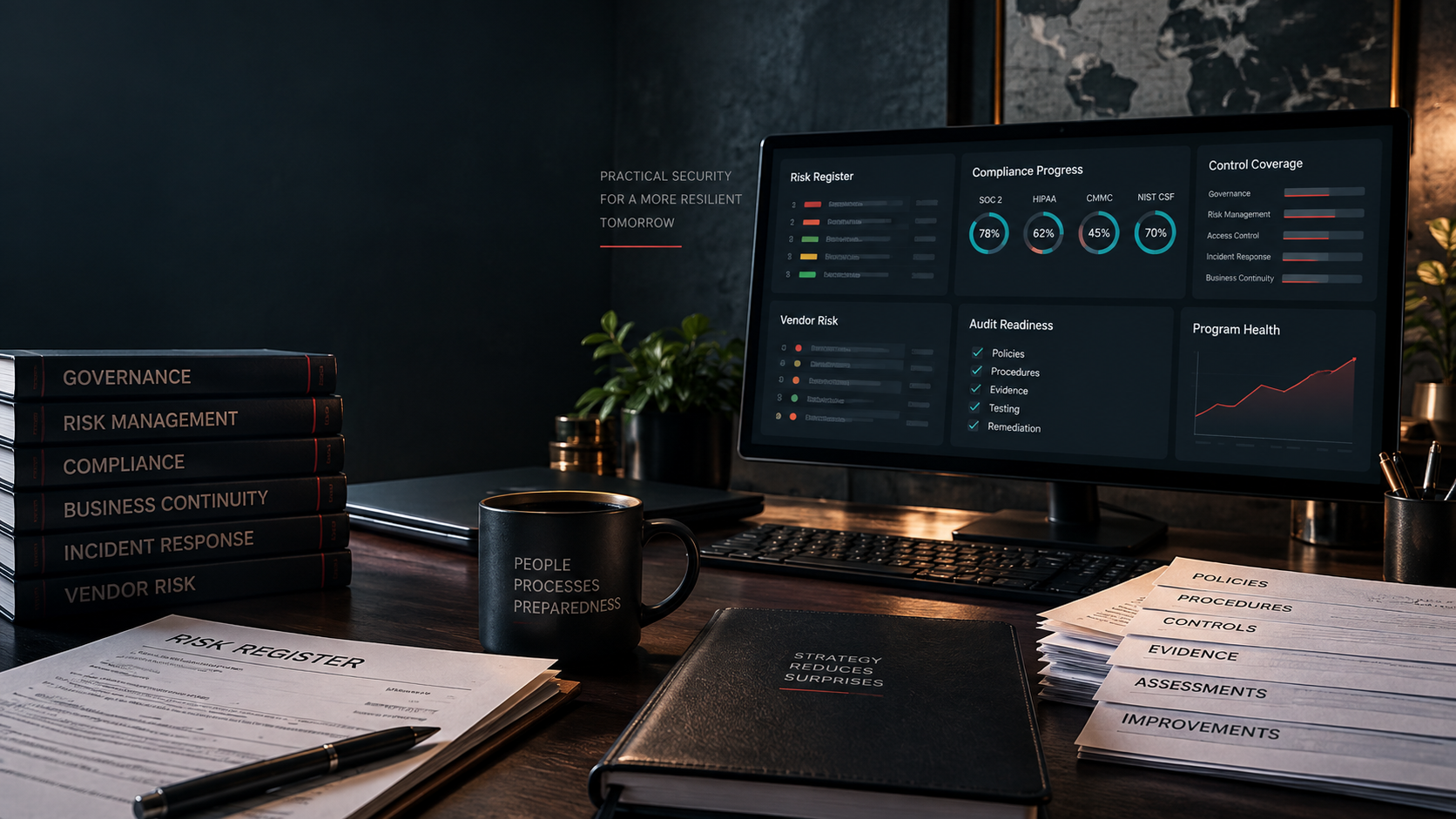
Governance, risk and compliance gets treated like a pile of documents because documents are the visible part. Policies. Risk registers. Questionnaires. Evidence. Assessments. Plans.
But a folder full of documents is not a GRC program any more than an incident response plan sitting untouched in a binder is an incident response capability.
The real function is ownership. Someone has to know what the organization is trying to protect, what obligations apply, where the risks are, what controls exist, what is missing, who owns the fix and whether anything actually changed.
NIST made that point harder to ignore when Cybersecurity Framework 2.0 added Govern as one of its six core functions. Governance is not decoration around cybersecurity. It is part of cybersecurity.
A company can have policies, frameworks, security tools and a pile of evidence and still have no clear owner for the work connecting all of it.
So what is fractional GRC?
Fractional GRC is ongoing governance, risk and compliance capability provided without hiring a full-time internal GRC employee or team.
The word “fractional” is less important than the operating model. The organization gets recurring access to someone responsible for moving the work forward, but only for the capacity it actually needs.
That can mean ten hours in one month and twenty-five in another. It can mean cleaning up a risk register before a customer review, answering a security questionnaire, mapping controls for SOC 2 readiness, updating policies, chasing evidence, preparing for CMMC requirements, reviewing vendors, or making sure last quarter’s remediation items did not quietly become next year’s remediation items.
It is not supposed to mean paying a consultant every month to attend meetings and generate attractive PDFs.
The GRC ownership gap
Small and midsize organizations often live in an awkward middle.
They are too mature to ignore governance and compliance, but not large enough to justify another full-time specialist sitting on payroll.
The work gets scattered instead.
- The IT manager owns the security questionnaire because it contains technical questions.
- The operations person owns business continuity because somebody had to.
- The CEO approves policies that nobody has reviewed since the last customer asked for them.
- An MSP manages systems but does not own the company’s business risk decisions.
- A consultant performs an assessment, delivers a report and disappears.
- Everybody assumes somebody else is following up.
None of those people are necessarily doing anything wrong. The operating model is wrong.
If everybody owns a little piece of GRC and nobody owns the function, the function does not have an owner.
What fractional GRC should actually do
A useful fractional GRC function should make the organization more organized, more defensible and less surprised.
Maintain the risk register
A risk register should not be a spreadsheet created for an assessment and buried afterward. Risks need owners, treatment decisions, deadlines, evidence and follow-through.
Keep policies connected to reality
Policies should describe how the organization operates or establish how it intends to operate. If the policy says one thing and everybody does another, the existence of the policy is not the win people think it is.
Handle customer and vendor pressure
Security questionnaires, vendor reviews and customer diligence increasingly become part of selling. Somebody needs to coordinate accurate answers, supporting evidence and remediation without inventing controls that do not exist.
Build audit and framework readiness
SOC 2, NIST CSF, NIST SP 800-171, CMMC, HIPAA and other requirements are easier to manage when the work is continuous instead of reconstructed in a panic two weeks before somebody asks for proof.
Connect resilience to compliance
Incident response and business continuity should not live in a separate universe from GRC.
A policy saying the company can recover is not evidence that it can recover. Plans need owners, exercises, lessons learned and maintenance.
When do you actually need it?
You probably do not need fractional GRC because somebody used the phrase on LinkedIn.
You may need it when the organization starts experiencing recurring governance work without recurring ownership.
- Customers regularly send security questionnaires or request security documentation.
- SOC 2, CMMC, HIPAA, NIST or contractual requirements are becoming commercially important.
- Policies exist but ownership, review cycles or implementation are inconsistent.
- The risk register is stale, incomplete or nonexistent.
- Evidence collection becomes a scavenger hunt every time somebody asks for it.
- Vendor risk is handled inconsistently.
- Remediation items are identified but not driven to closure.
- Your MSP or technical team is being asked to make governance decisions outside its role.
- You need continuity without enough work to justify a full-time GRC hire.
Fractional GRC versus a full-time hire
A full-time employee makes sense when the workload, complexity and organizational size justify a dedicated role.
Fractional support makes sense when the function needs consistent ownership but not forty hours of labor every week.
There is also a third option: project consulting.
Projects are useful when the problem actually has an end. Perform an assessment. Build an incident response plan. Prepare a specific package.
But recurring work has an annoying habit of recurring.
The risk register changes. Customers ask new questions. Vendors change. Employees change. Evidence ages. Contracts change. Controls break.
New systems appear because somebody bought software with a corporate card on a Tuesday.
A one-time project cannot own what happens six months later.
Where automation and AI belong
Automation can make GRC dramatically less painful.
It can organize evidence, map controls, identify stale documents, accelerate questionnaires, track tasks and help analyze large amounts of information.
That is useful. We use technology too.
But automation does not become accountable because the dashboard has a gradient.
Someone still has to decide whether a risk is acceptable.
Someone has to know whether an answer is accurate.
Someone has to understand why a control exists, whether evidence proves what people think it proves and what happens when the business reality does not match the template.
NIST’s small-business guidance recognizes the same basic resource problem: smaller organizations may develop capability internally, train existing employees or use outside partners for specialized cybersecurity work.
Automate the work that should be automated. Do not automate accountability out of the system.
What fractional GRC is not
It is not an auditor pretending to be management.
It is not a certification.
It is not legal advice.
It is not a magic SOC 2 button.
It is not a vCISO with a new label slapped on it because marketing needed another service page.
There can be overlap with a vCISO, especially around strategy and risk.
But fractional GRC is usually closer to the operating machinery: registers, controls, policies, evidence, questionnaires, remediation, vendor risk and readiness.
The goal is not to create more compliance activity.
The goal is to make the activity you already need coherent.
A simple test
Ask these five questions:
- Who owns our cybersecurity and compliance risk register?
- Who knows which security obligations actually apply to us?
- Who makes sure identified gaps are fixed rather than merely documented?
- Who can produce current evidence when a customer, auditor or partner asks?
- Who is responsible for keeping all of this current next month?
If five questions produce five different names, three shrugs and a reference to a shared drive, you have learned something useful.
The point
Growing companies do not suddenly wake up one morning and become enterprises with mature governance departments.
The obligations arrive first.
Customers want evidence.
Contracts create requirements.
Vendors create risk.
Frameworks create structure.
Incidents expose assumptions.
Growth adds complexity.
You can wait until there is enough chaos to justify a full-time hire, or you can establish ownership before that point.
That is the argument for fractional GRC.
Not more paperwork.
Ownership.
Forward Security Labs provides ongoing GRC support for organizations that need practical help with risk registers, policies, vendor risk, security questionnaires, framework readiness, business continuity and incident response documentation without adding another full-time position.
Explore ongoing GRC supportNIST Cybersecurity Framework 2.0: NIST Cybersecurity Framework
NIST Small Business Quick-Start Guide: NIST CSF 2.0 Small Business Quick-Start Guide
Forward Security Labs supports readiness, implementation and ongoing GRC activities. FSL does not provide certification, independent audit opinions, C3PAO assessments or legal advice.