Emergency Medical Software Compliance
Emergency Medical Software Compliance: 9 Questions for EMS Leaders
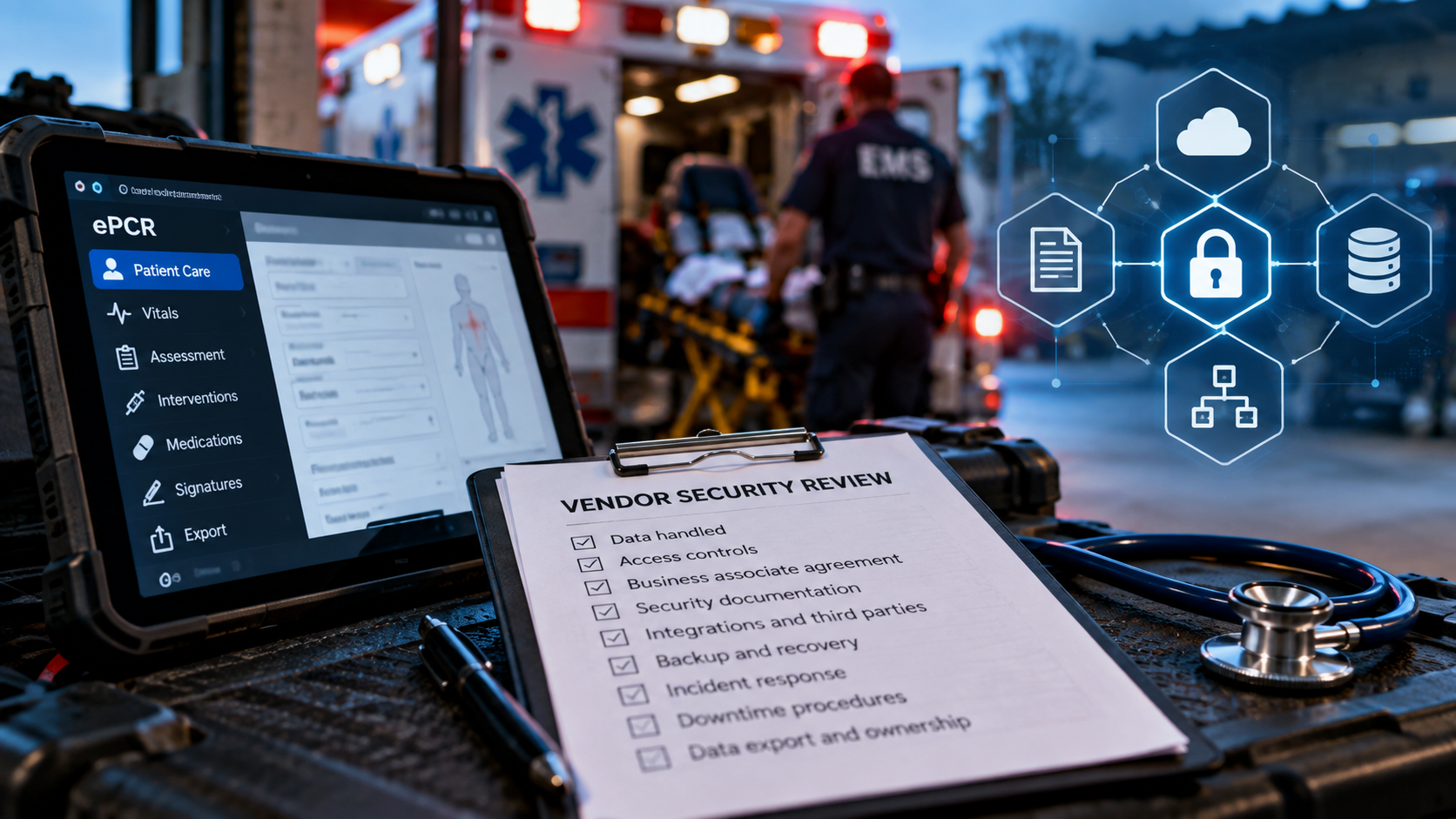
Emergency medical software compliance is not just an IT problem. An ePCR platform, dispatch system, billing interface, cloud service, or integration can affect patient information, operational continuity, documentation, vendor risk, and the ability of an EMS agency to keep functioning when technology fails.
Before purchasing, renewing, or expanding an EMS technology platform, leaders should understand what data the system handles, who can access it, what happens when it becomes unavailable, and which security responsibilities belong to the agency versus the vendor.
What Emergency Medical Software Compliance Requires You to Examine
A vendor saying that a product is “HIPAA compliant” does not end the conversation. Compliance depends on how technology is configured, used, integrated, managed, and supported within the organization.
EMS leaders should review software as part of the broader environment in which electronic patient information is created, received, maintained, transmitted, accessed, and recovered.
1. What patient or operational data does the system actually handle?
Start with the data. Determine whether the application creates, receives, stores, transmits, displays, or provides administrative access to electronic protected health information.
Consider more than the obvious patient record. Data may also move through interfaces, exports, backups, analytics platforms, billing systems, mobile devices, hospital connections, support tools, and third-party integrations.
2. Does the vendor require access to protected health information?
The relationship with a software vendor depends partly on what the vendor can access and what services it performs. Hosting patient information, remotely troubleshooting systems containing patient information, managing cloud infrastructure, or otherwise accessing protected data may create business-associate obligations.
Do not rely only on the vendor’s marketing language. Document what the vendor can actually access and why.
3. Is responsibility clearly divided between the vendor and the EMS agency?
Cloud and hosted systems frequently use shared responsibility models. The vendor may secure infrastructure while the customer remains responsible for user accounts, permissions, authentication settings, endpoint security, configuration, workforce practices, and other controls.
Write down who owns each responsibility. “The vendor handles security” is not an adequate operating model.
4. How are users authenticated and access privileges controlled?
Review how accounts are created, changed, disabled, and monitored. Ask whether the platform supports individual accounts, strong authentication, role-based access, privileged-account controls, and timely removal of access when employees leave or change roles.
EMS operations often involve shift work, shared environments, field devices, supervisors, billing personnel, administrators, and outside partners. Access controls need to reflect that reality.
5. What evidence can the vendor provide about its security program?
Ask what documentation is available to support the vendor’s security claims. Depending on the product and risk, useful material may include security questionnaires, independent assessments, certifications, penetration-test summaries, policies, architecture information, incident-response information, or other assurance documentation.
The goal is not to collect documents for decoration. The goal is to determine whether the evidence supports the representations being made.
If reviewing vendor questionnaires and supporting evidence is becoming a project of its own, see Forward Security Labs security questionnaire support.
For a focused review of ePCR, dispatch, vendor access, and downtime dependencies, see the EMS cybersecurity assessment.
6. What happens when the software is unavailable?
For EMS, availability is not an abstract cybersecurity metric. Dispatch, ePCR, communications, mapping, interfaces, billing systems, and hospital connectivity can directly affect how work gets done.
Determine how crews will operate during an outage, how information will be documented, how records will be reconciled afterward, and which decisions require escalation.
The EMS Downtime Exercise Guide provides a practical starting point for testing those decisions before an actual outage.
7. What are the backup, recovery, and data-export options?
Understand where data is stored, how it is backed up, how restoration works, and whether the agency can obtain usable information if the vendor relationship ends.
Ask practical questions. How quickly could critical records be restored? What happens during a regional cloud outage? Can the agency export its information in a usable format? Who owns the recovery process?
8. How does the vendor handle security incidents?
Review notification procedures, escalation contacts, investigation responsibilities, contractual reporting requirements, and how the vendor communicates during an incident.
The first time an EMS leader learns the vendor’s incident-notification process should not be while systems are already unavailable.
For broader preparedness planning, see the Healthcare Ransomware Tabletop Checklist.
9. Has the software been included in the organization’s risk analysis?
A software procurement review is not a substitute for an organizational risk analysis. Technology that creates, receives, maintains, or transmits sensitive information should be considered within the organization’s broader assessment of risks and vulnerabilities.
The review should also be revisited when systems, integrations, vendors, workflows, threats, or organizational responsibilities materially change.
Emergency Medical Software Compliance Should Produce Usable Documentation
A practical emergency medical software compliance review should leave behind more than meeting notes. Depending on the environment, useful outputs can include:
- A system and data-flow inventory
- A vendor and integration list
- Business-associate and contract review items
- Access-control responsibilities
- Security questionnaire responses and supporting evidence
- Known gaps and remediation owners
- Downtime and continuity procedures
- Incident escalation contacts
- Backup and recovery expectations
- Renewal or procurement decision documentation
Those artifacts help turn vendor security from a once-a-year questionnaire into an operating process.
Software Security Is Only Part of EMS Readiness
A technically capable platform can still create operational risk if roles are unclear, downtime procedures are unrealistic, evidence is scattered, or staff do not know what to do when the system fails.
For agencies that need broader planning and exercise support, see Emergency Preparedness Consulting.
For policies, risk registers, control mappings, evidence packages, and other defined work products, see Cybersecurity Documentation Services.
Official Guidance for Emergency Medical Software Compliance
Emergency medical software compliance should be evaluated against the actual data, systems, vendors, and responsibilities involved in the organization.
The U.S. Department of Health and Human Services explains that a software vendor may become a HIPAA business associate when the services it provides involve access to protected health information.
Review the official HHS guidance: When a software vendor may be a HIPAA business associate .
HHS also explains that using a cloud service provider does not transfer all security responsibilities to the vendor. Covered entities and business associates still need to understand their environment, conduct appropriate risk analysis, manage responsibilities, and use appropriate agreements when electronic protected health information is involved.
See: HHS guidance on cloud services and electronic protected health information .
A useful emergency medical software compliance review connects vendor assurance, security responsibilities, downtime planning, documentation, and operational ownership instead of treating each as a separate exercise.
Need Help Reviewing an EMS Technology Risk?
Forward Security Labs can help organize vendor-security questions, documentation gaps, continuity considerations, evidence, and readiness work around a defined project.
Talk to Forward Security Labs